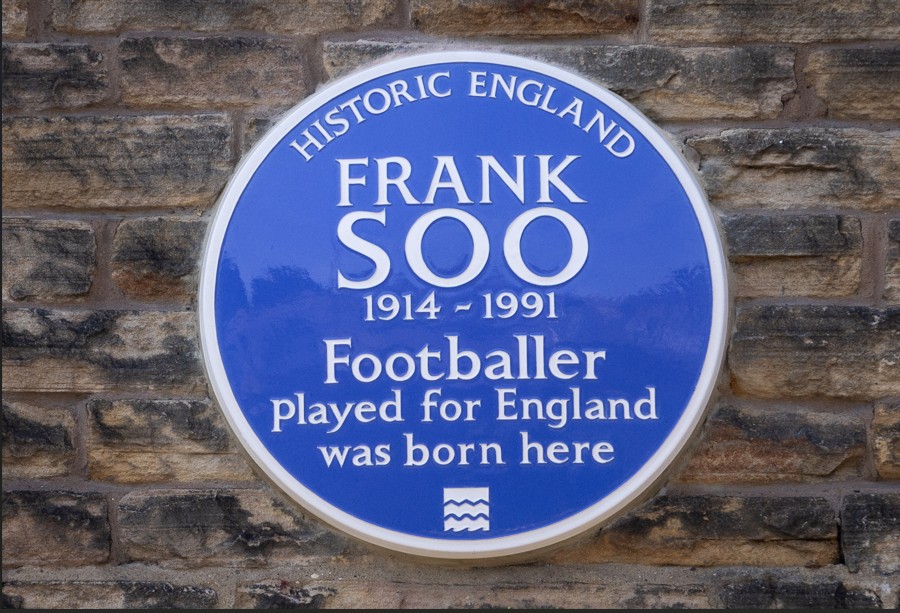
On 10 July, Historic England unveiled its latest commemorative marker in the National Blue Plaque Scheme. I am on the panel that selects these plaques, and as this was a sporting one, to footballer Frank Soo (1914-91), I was honoured to make a speech on behalf of the Panel at the unveiling in the Derbyshire town of Buxton. I was joined on the panel by Jacqui Soo, Frank’s great-niece and a tireless campaigner for proper recognition for her great-uncle, and Claudia Kenyatta, Co-Chief Executive of Historic England. We gave our speeches in the Buxton Working Men’s Club, then moved next door to Soo’s birthplace, 11 Lightwood Road, for the unveiling by Jacqui and other members of the family. It’s always great to meet family members on occasions like this, and to see the positive impact that public commemoration can have on family members and communities alike.
Here is the text of my speech.
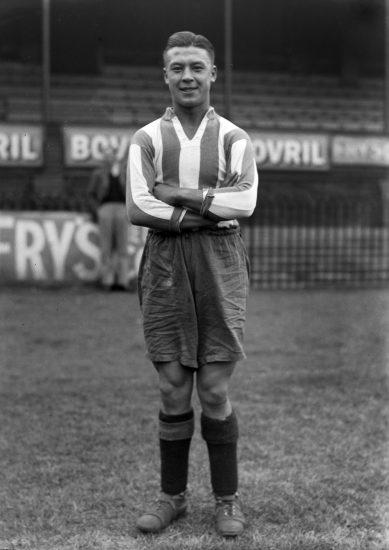
On behalf of the Historic England National Blue Plaque Panel, I’m delighted to join you in unveiling our latest Plaque, dedicated to footballer Frank Soo. Soo was a household name in his playing days in the 1930s and 1940s, when he played alongside such legends as Stanley Matthews and Tommy Lawton, though he has dropped from sight while those other players have retained their place in the game’s and the nation’s popular memory. Our aim in honouring Frank Soo with this plaque is to help put that right.
Frank Soo was born in this house in March 1914. His mother Beatrice was a white English woman from Manchester, and his father Quan, born in Guangzhou, was a member of that city’s Chinese community. Like many of his peers, Quan Soo ran a laundry, and it was this trade that brought the family here to Fairfield. This building was both their business premises and their home.
The family moved on to Liverpool, and Frank, always a talented footballer, worked his way up through youth teams and on to Prescott Cables, where Second Division Stoke City spotted him in January 1933. He went on to play 173 times for Stoke between then and 1945, at inside-left, half-back and other positions, and served as their captain. It was during Frank’s career at Stoke that they achieved their highest ever league finish, fourth in the First Division in 1935-36. Despite regular press calls for his international selection, he did not make the England team until 1942, under wartime conditions, and he played for his country nine times in wartime and Victory internationals. He served in the RAF during the war, and captained their service team in many exhibition matches, while also playing as a guest at Brentford, Newcastle, Chelsea and other clubs. Frank’s post-war career took in Leicester City, Luton Town, and Chelmsford City, along with coaching and managerial positions in England, Italy, Finland, Sweden, and Denmark, and national team roles with Norway and Israel, though his contract with the latter was terminated before he took over. He retired to Stoke, where he remained a hero, and died there in 1991 at the age of 76.
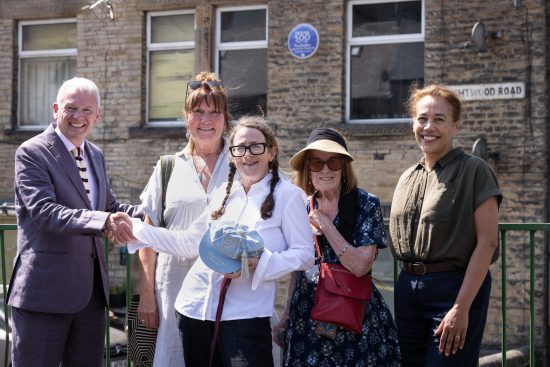
Me with family members Joanne Hopper, Jacqui Soo, Rita Soo, and Historic England’s Claudia Kenyatta at the unveiling. Photo: James Speakman/PA Media Assignments
What was special about Frank Soo? His playing style stands out in all the press reports. The Express praised him as ‘a master of the long, sweeping pass on the carpet’, while the Evening News commented on his ‘fine constructional play, with never a ball wasted’. He was clearly a skilful, intelligent, and entertaining player. I’m also struck by other aspects of his career. He was always dedicated to fitness, and was that rare thing in football networks of those days, a non-smoking teetotaller. As a coach, he expected similar dedication from his players – he ran into trouble when coaching in Sweden by banning his players from having a post-match beer. He was a pioneer in football’s transnational networks, with a coaching career that took him from St Albans to Stockholm via Padua and Scunthorpe. He was an outspoken advocate of footballers’ employment conditions in what was essentially a feudal time of the maximum wage and a transfer system that gave clubs immense control over players’ lives: the fact that he frequently fell-out with club owners in both his playing and coaching days speaks to his commitment to player solidarity. Finally, and underpinning it all, was his ethnicity: as the son of a Chinese migrant, he was the first footballer of east Asian heritage to play professionally in the Football League, and the first – and still, in 2026, only – player of that ethnic background to play for England.

Crowds at the unveiling. Photo: James Speakman/PA Media Assignments
Frank Soo’s England career took place under wartime and early peace time conditions, and the Football Association did not award caps for these games. His appearances were thus hidden from history for decades. In 2025, the FA reviewed this and awarded Frank a posthumous honorary cap in recognition of his role as a ‘trailblazer’. The National Football Museum has also inducted Frank into their Football Hall of Fame. In unveiling this plaque, we are proud to add Historic England’s recognition of Frank Soo’s life and achievements to these commemorations. When we started this National Blue Plaque Scheme, one of our goals was to celebrate inspirational pioneers and quiet revolutionaries. Frank Soo fits that bill perfectly.
Find out more about Historic England’s National Blue Plaque Scheme.
