For my birthday last year, my wife and I started on a long-term project of walking the Thames Path, from Woolwich in east London to the river’s source in a field in Gloucestershire. We’re breaking it up into sections, walking a stretch whenever we get the chance, and have so far reached Goring in Oxfordshire, 99 miles in.
The river is obviously the unifying feature that forms the setting for the walk, and it provides a great way to intersect with history. The route takes in post-industrial wastelands near Greenwich and the regeneration of the London’s docks, the legacies of the Festival of Britain on the South Bank, churches and cathedrals, palaces and parliament, bridges and locks, lost pleasure gardens, and so much more.
For an Olympic historian, there are also many intersections between the river and the sporting past, including places where London’s three Olympic Games (1908, 1949, and 2012), and some of the UK’s pre-Coubertin Olympic and Olympian events, took place. The route goes through the heart of London 2012’s River Zone, passing the O2 (which was rebranded as the North Greenwich Arena for the Olympics to avoid a sponsorship clash), and Greenwich Park. Further west, and looking across the river from the south, we passed the tiny remaining part of Cremorne Gardens, the Chelsea pleasure gardens that advertised a six-day Olympic Games as part of its 1832 programme, quickly followed by the Hurlingham Club, site of the polo competition in 1908, then Fulham FC’s Craven Cottage, one of the grounds to host football in 1948.
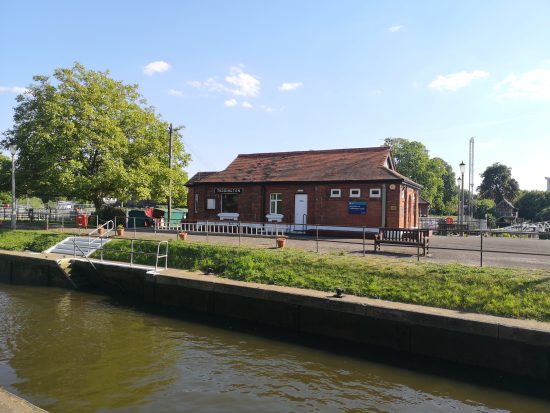
Then comes Teddington Lock, the venue for the swimming events at the first National Olympian Games in 1866; Hampton Court Palace, base for the cycling time trials in 2012; and a tiny intersection with the 1908 Olympic Marathon route at Windsor.
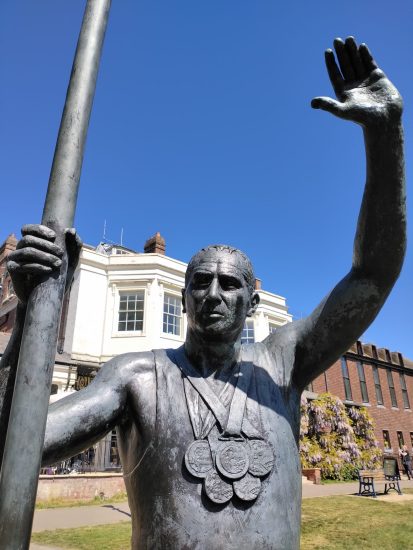
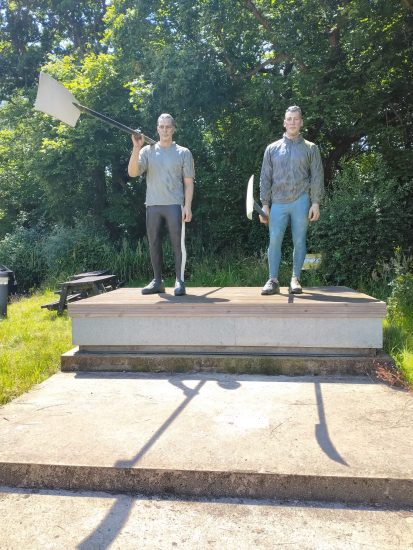
One of our recent walks brought this Olympic history into sharp focus as we covered the 8.5 miles from Marlow to Henley-on-Thames. Fittingly, it’s a route that has statues of legendary British rower Steve Redgrave at the start and finish: Neale Andrew’s bronze of him in Higginson Park, Marlow; and Sean Henry’s double statue of Redgrave with his rowing partner Matthew Pinsent outside the River and Rowing Museum in Henley.
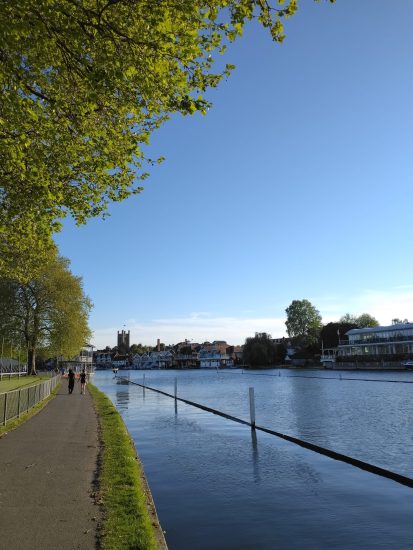
Henley can easily feel like a single industry town, based around rowing – a bit like Newmarket is for horse racing. Its annual Royal Regatta and Women’s Regatta dominate the town’s calendar, and boathouses, organisational headquarters, and the currently-closed River and Rowing Museum mark out the townscape, albeit some of these are on the opposite bank of the Thames from Henley itself. The Regatta course is permanently marked out by wooden booms stretching for over two kilometres, the only place on the river where permanent sporting infrastructure resides in the water itself. The exact course has changed in a few details since the first regatta in 1839, but they have all run from Temple Island to a finish line close to Henley Bridge. It was this course that hosted the rowing events at both the 1908 and the 1948 Olympics.
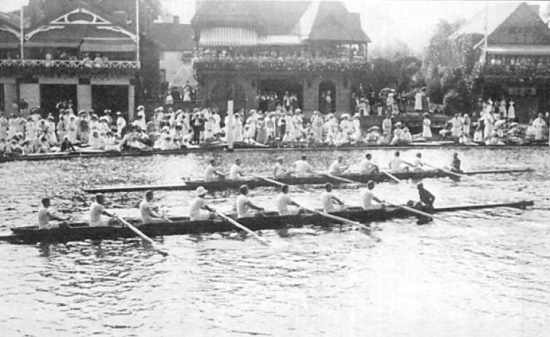
In 1908, there were just four events in an all-male competition – single sculls, coxless pairs, coxless fours, and coxed eights. British crews dominated: despite these being the first Olympics at which national teams were supposed to be the basis for all representation, some sports had so many British competitors that the country entered multiple teams, with club being more significant than country. The final of the coxless pairs, for example, involved two pairs from Henley’s Leander Club, while the coxed fours saw a gold medal race between Oxford’s Magdalen College Boat Club and Leander. All four golds went to Britain. Clubs and individual rowers from Belgium, Canada, Germany, Hungary, Italy, and The Netherlands also competed, though Belgium’s Royal Club Nautique de Grand was the only one to make a final, taking silver in the coxed eights.
The Games grew massively between 1908 and Henley’s next Olympic regatta, in 1948. The club-based character of 1908 was formally over, with crews being selected on a more truly national basis, and the international spread of the Olympics meant that teams form 27 nations competed, including Brazil, the USA, Australia, and Egypt. It was still a sport that was only for men at the Olympics – the IOC did not open rowing to women until 1976. However, Henley also hosted the canoeing event of the 1948 Olympics, which did include women for the first time. The canoeists used the same Regatta course as the rowers, although they had to stick to specific metric distances, leaving the 10,000 metres canoeists paddling the same route four times, twice each upstream and downstream.
By 2012, the rules and formats had changed. The Henley course can accommodate only two boats in a side-by-side race, and even before London 1948 this model was out-dated. At Berlin in 1936, races had involved six boats starting side-by-side, and this format became the norm from Melbourne 1956 onwards. The historic and natural course at Henley thus became obsolete as far as the Olympics were concerned, though it has retained its place at the UK’s more important regatta route. For 2012, the rowing took place on the artificial Dorney Lake, 23 miles back along the footpath towards London.
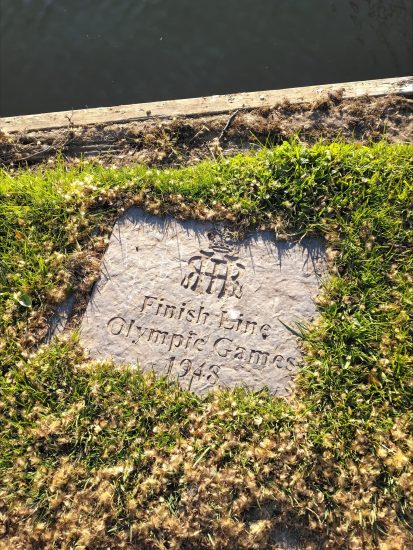
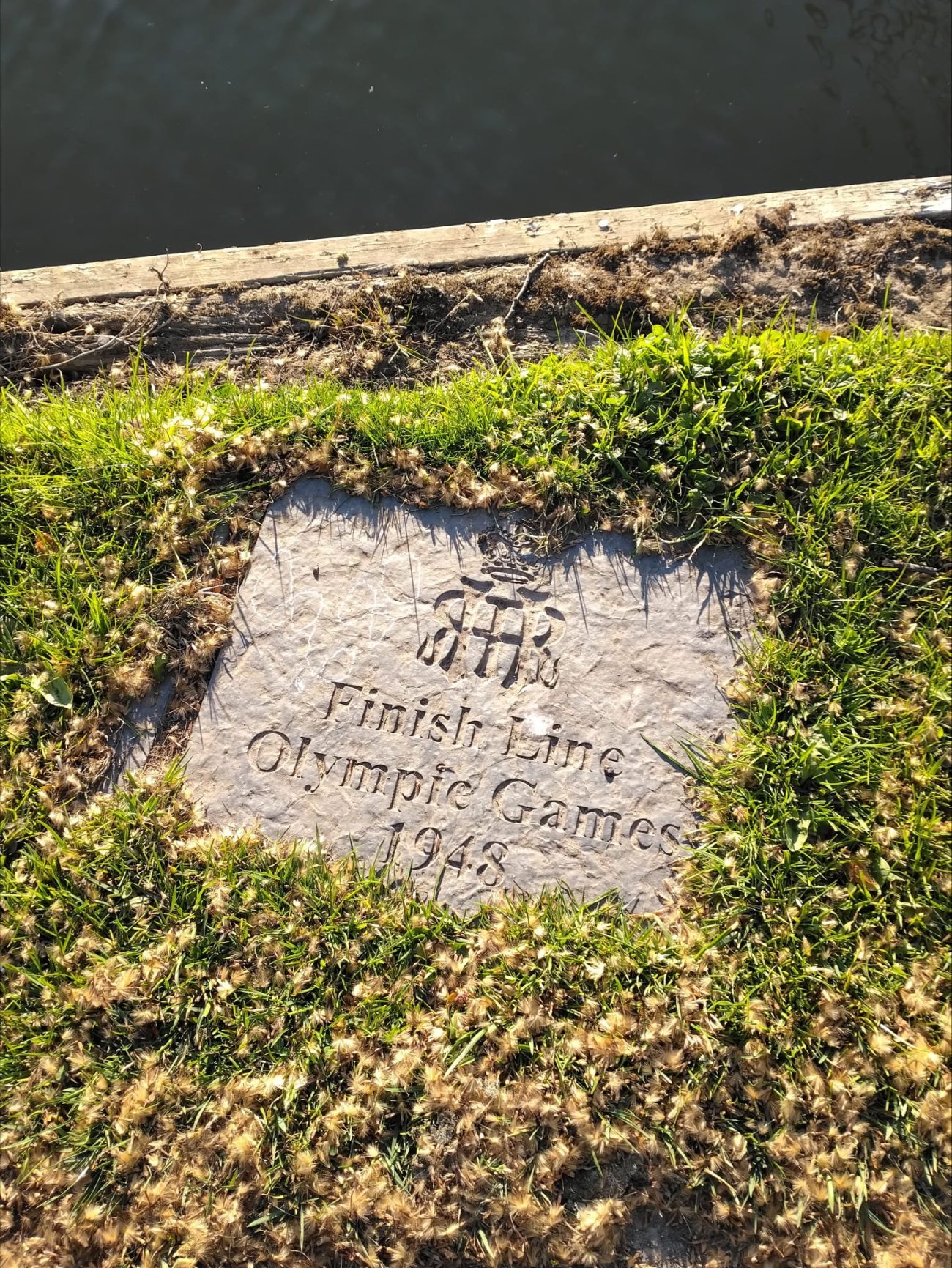
The River and Rowing Museum (closed at the time of writing) offers a wonderful insight to all aspects of rowing history, at Henley and beyond. And there small stone plaques set into the grass to mark the finishing lines of the 1908 and the 1948 Olympic course. Here is some concrete remembrance for a two-time Olympic venue that can never take the Games again.
We still have many miles to go before we reach our finishing line: but it’s great to see markers such as this one that can remind all visitors of the river’s history as an Olympic and Olympian venue.
