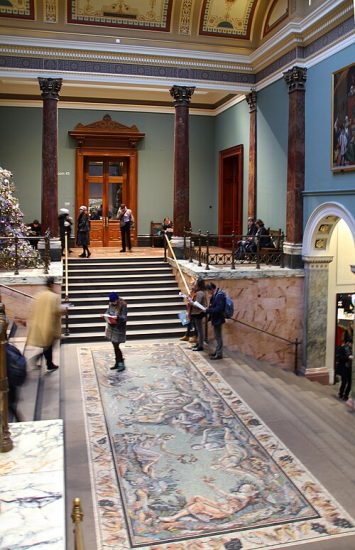
When I was first studying urban history, one of my tutors, the late Peter Borsay, taught me a basic but essential mantra: ‘Look Up!’ On a recent visit to the National Gallery in London I appreciated the opposite approach, thanks to a tip off from Rachel Howard and Bill Nash’s quirky guidebook, Secret London. By looking down, I saw for the first time Boris Anrep’s mosaics in the Gallery’s portico, complete with their images of sport.
Anrep (1885-1969) was born in St Petersburg, and he lived and worked in Paris for much of his life. Many of his mosaic commissions, inspired by the stunning Byzantine art he saw in Ravenna, were undertaken for buildings in London, with work in Westminster Cathedral, Tate Modern, the Bank of England, and other churches and private houses. According to Howard and Nash, Anrep ‘liked the idea of visitors walking on his works of art’, a fact which Elle Anderton noted: these beautiful and idiosyncratic pieces are ‘hidden in plain sight’. I plead guilty as charged: I have walked over them dozens of times, but never once looked down before. It’s well worth the slight change in angle.
Anrep undertook the National Gallery work between 1928 and 1953. There are four sections: ‘The Awakening of the Muses’, ‘The Modern Virtues’, ‘The Labours of Life’, and ‘The Pleasures of Life’. He peppered the designs with portraits of people he knew through his artistic connections, particularly with the Bloomsbury Group. Virginia Woolf, T S Eliot, Margot Fonteyn, Bertrand Russell, Clive Bell, Greta Garbo, and Winston Churchill are all there, posing as muses or as the personification of virtues.
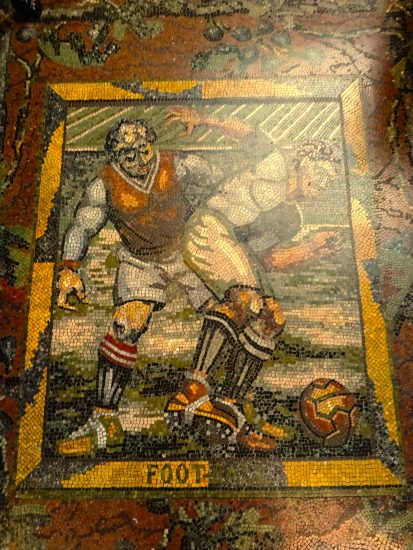
Leaving aside the overall value of this work, I was – obviously – drawn to the panels that deal with sport. These are part of the ‘Pleasure of Life’ sequence in the East Vestibule, alongside images of Christmas puddings, contemplation, conversation, rest, and dancing, and they offer a balance to the opposite side of the hall where the ‘Labours of Life’ cover exploration, art, farming, science, commerce, and more. These images are, as the National Gallery puts it, ‘a celebration of everyday life, which lies underfoot in a busy public place’.
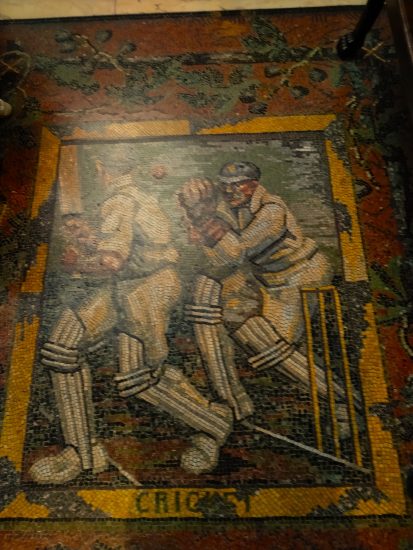
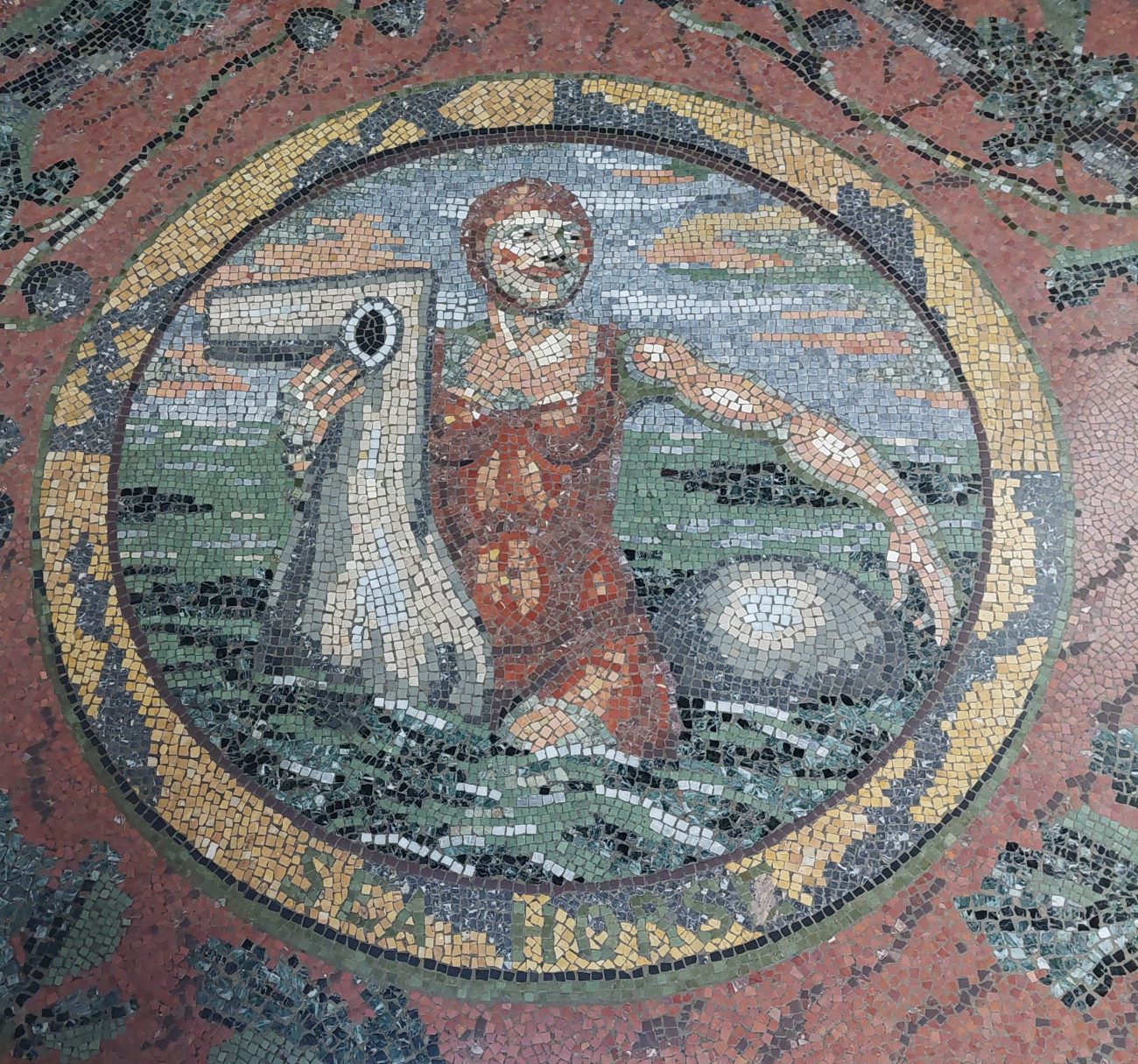
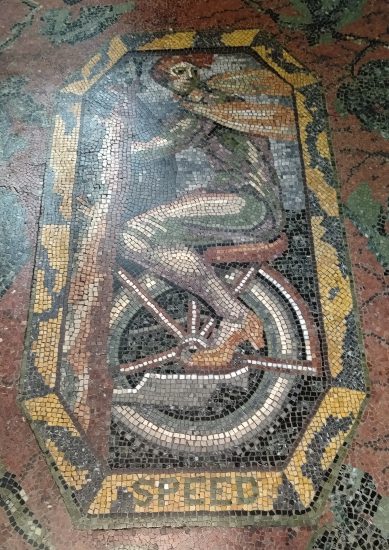
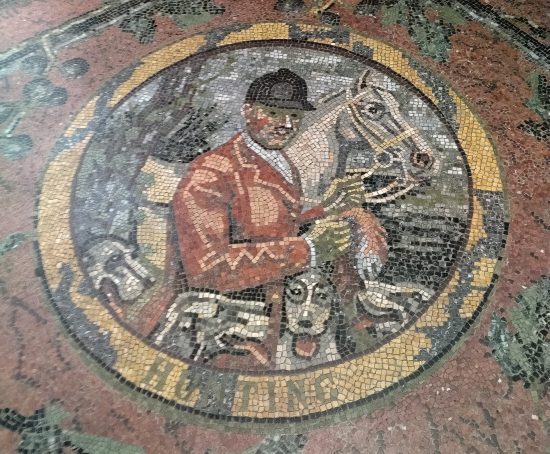
‘Cricket’ appears, a close-up of a batsman about to be caught out by a wicket keeper. Football shows two players on a wet and muddy pitch in a tackle, while a smiling huntsman and one of his hounds stare straight out from the Hunting panel. The panel called Speed is more about leisure than sport, but its representation of a young woman riding pillion on a motorcycle, her scarf and hair flying behind her in the breeze, resonates with the sense of modernity that was so central to motor sports in the 1920s and 1930s. Modernity is also present in Sea Horse, about play rather than sport, with a woman in a bathing suit and swimming cap playing in the sea on an inflatable.
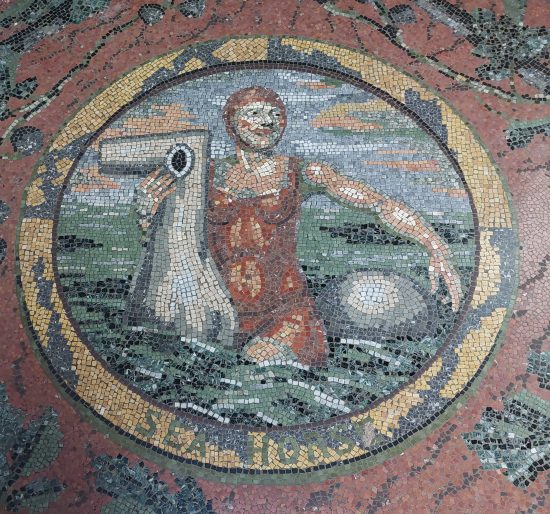
These panels are small pieces, but the detail that Anrep captured with tiny differences in the colours of the tiles is fantastic. Look at the heeled-shoes of the woman in Speed, the hefty football boots, the hound’s wagging tongue, the wicket-keeper’s determined look as he gets ready to catch the ball, and the movement of small waves captured in Sea Horse. The compositions offer us a wonderful way in to sport in this period, with its mix of seriousness and play, and the presence of modern women in physically active roles.
It’s hard to get a great view of the mosaics, especially as they now lay between benches that are popular places for visitors to rest – I had to make some polite requests for people to move their feet so that I could get the photographs on here, and the lighting is not perfect. But you should make time to find these pieces next time you are in London, and to spend some time looking down at the ground before you look up at the gallery walls.
