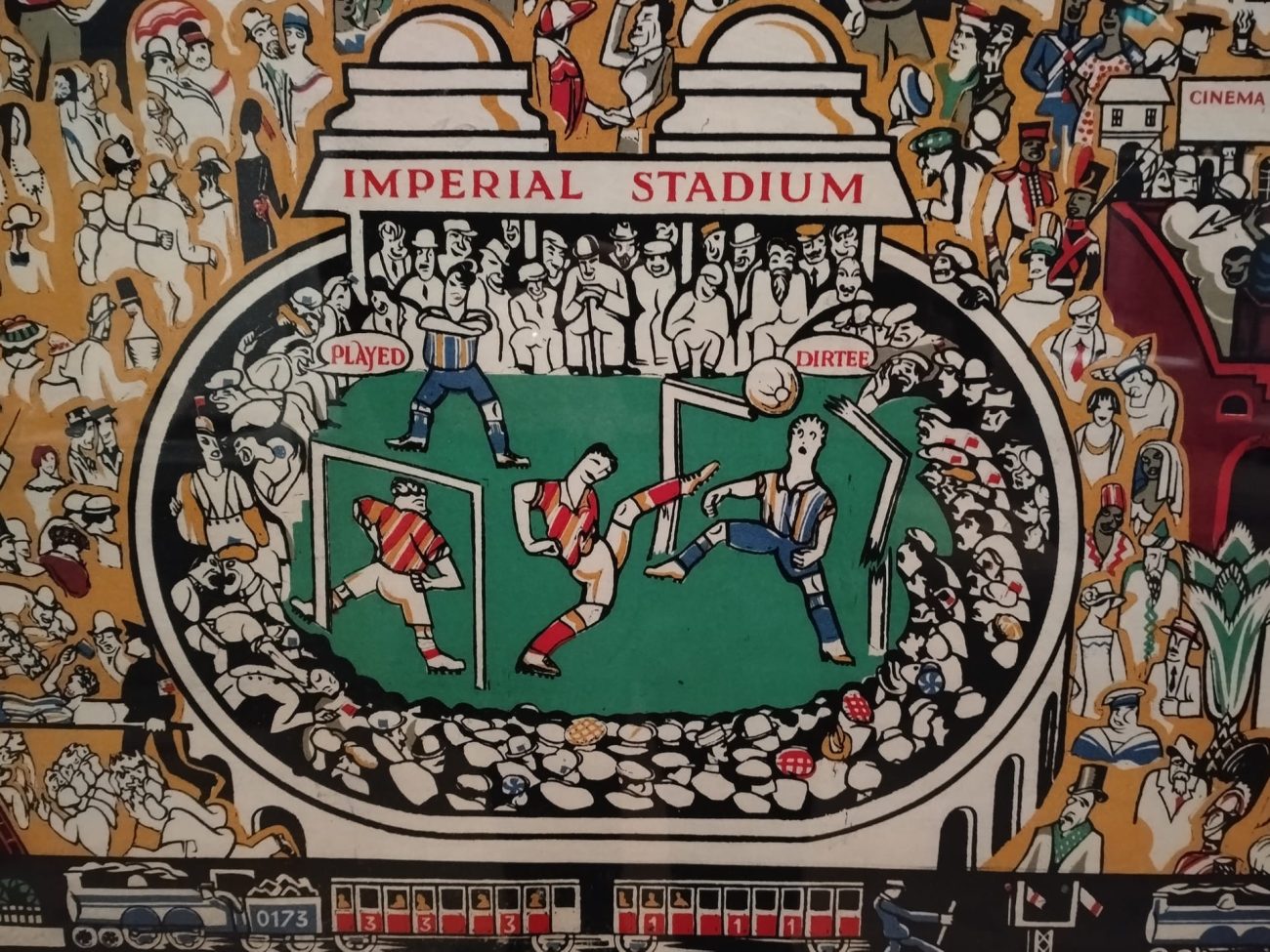
Last week I came across a stylised image of Wembley Stadium in an unexpected place.
The wonderful Compton Verney art gallery in Warwickshire is currently staging an exhibition called The Pattern of Life: Enid Marx and Modern British Design, curated by Az Crawford. As well as Marx’s work, the exhibition includes pieces produced by people in her networks in London’s interwar art and design world, including Edward Bawden and Thomas Derrick’s poster for the British Empire Exhibition, which ran at Wembley from April to November 1924 and May to October 1925. The poster, on loan to Compton Verney from the London Transport Museum, depicts a joyful imaginary version of the Exhibition, with hundreds of people arriving by bus, train, and Underground. And in the bottom left you’ll find the Stadium, which was built for the Exhibition, with a match in progress.
The match is a stylised 2 v 2 in which one striker’s shot has just smashed the crossbar and goalposts. There is a lot to unpack in the tiny cameo which is hilariously inaccurate as a depiction of football match. There is no kit differentiation between outfield players and goalkeepers in this 2 v 2 version. The players – especially the red and orange team – are wearing shirts that are more reminiscent of Soviet designer Varvara Stepanova’s constructivist designs than of what English clubs’ kits looked like in 1924. There are no pitch markings or goal nets, no officials, and two of the players are simply standing around looking tough with with their hands on hips or their arms crossed, while the striker’s pose is far more balletic than sporting.
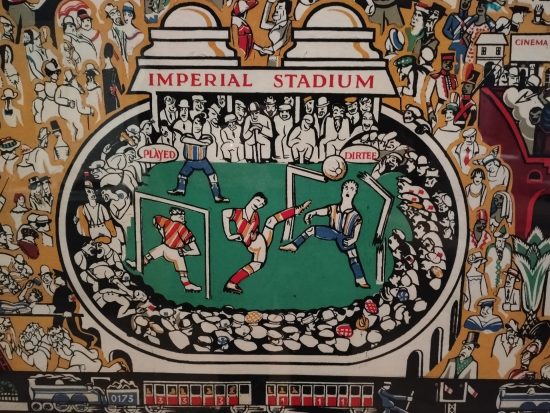
The crowd is also worth a look. The spectators watching from beneath the twin towers look like connoisseurs of the game, especially the man leaning on his stick in the centre. Behind the broken goal, angry looking spectators lean in, and one hollers ‘DIRTEE’. One man is even craning over the stadium wall to watch. At the ether end, some of the fans are smiling, and one shouts ‘PLAYED’. (I might try to start a revival of shouting ‘Played’ and ‘Dirtee’ at my next Brentford match). There is also a brawl breaking out as spectators face up to each other. One fan of the red team is getting a sharp jab to the jaw, while another fan strips off his jacket to join the scrap. Just outside the stadium, we see stretcher bearers carrying one of the blue-shirted team off. Overall, Bawden and Derrick provided a stylised comical snapshot of a match and its crowd. Its not flattering, and it certainly isn’t promoting any sort of golden age image of the game, but it fits perfectly with the overall mood of the poster.
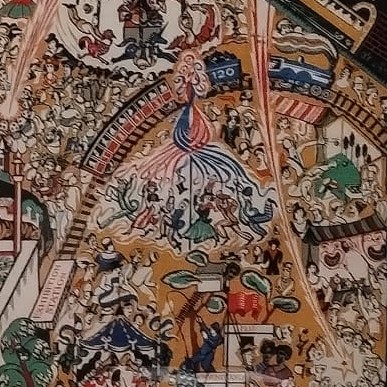
The wider poster is a fascinating snapshot of how the promoters wanted the Empire Exhibition to appear. It is largely joyful – apart from the fight in the stadium – and filled with action. There are funfair rides, fireworks, water features, restaurants, picnics, military bands, and a rather manic-looking dance around the maypole. These depictions of the exhibition-goers at play mix in with the heavy work taking place in the displays dedicated to Industry and Engineering.
The Exhibition was designed to celebrate Empire, and this theme runs through the poster. British Colonies and Dominions have their stands, and the comic touches that Bawden and Derrick used for the football match come through here, too. A South African miner displays the kind of jewel that Scott Fitzgerald might have had in mind in his story ‘A Diamond as Big as the Ritz’. Outsized Mounties pose outside the Canada pavilion, with an indigenous village in the background. Elephants, camels, and tigers emphasise the exoticism of the India and East Africa stands, while white spectators point at the exhibited black woman carrying a bunch of bananas on her head in the West Indies’ area. The poster reminded me of the opening chapter of Andrea Levy’s 2004 novel Small Island, where Queenie tells her schoolmates ‘I went to Africa when it came to Wembley’. She remembers seeing Indian and African people presented as uncivilised, exotic, and other, working on their handcrafts while the British were being celebrated for their modern, machine-based ways of manufacturing.
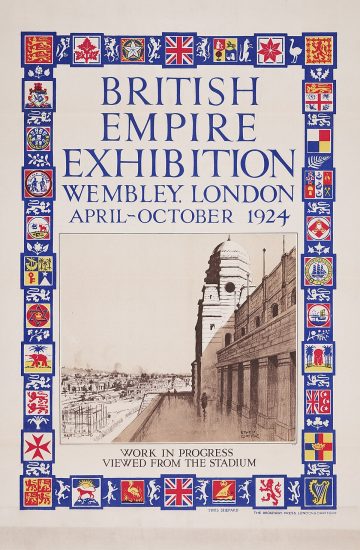
The cameo of the football match reminds us how sport fitted into this moment of British history. The legend ‘Imperial Stadium’ surmounts the ground, which was built in 1923 as part of the development of Wembley Park for the 1924 Empire Exhibition. It carried the names ‘British Empire Exhibition Stadium’ and then ‘Empire Stadium’, the latter lasting for decades. As we smile at Bawden and Derrick’s comic depiction of the football match, this poster serves as a fantastic visual gateway to how London Transport wanted to celebrate London as an imperial city. Remember this context next time you visit the new Wembley Stadium. The original stadium, like the rest of the Exhibition’s architecture, has gone: but the 1924 exhibition that contained, in Queenie’s words, ‘building after building that housed every country we British owned’, was the exact setting for the ground that became such a central part of British sporting history.
The Pattern of Life: Enid Marx and Modern British Design runs at Compton Verney, Warwickshire, until 3 January 1927.
For Wembley’s history as a sporting landscape, see Simon Inglis, Played in London: charting the heritage of a city at play (English Heritage, 2014).
