
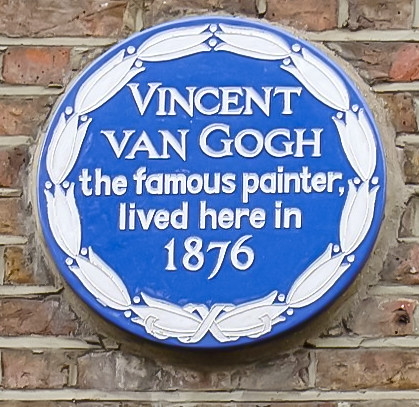
Seeing blue plaques that commemorate famous people was one of my childhood gateways into history. I have clear memories of noticing these beautiful discs on houses and public buildings when I was growing up in suburban west London, and of asking my Dad, who loved history, what they were for. He told me that they were to mark the places that famous people had lived, and – juvenile history nerd alert – it gave me a buzz to know that these people had walked the same streets as me. My most distinct memory of this kind of chat came when I saw, from the bus window, a plaque to the artist Vincent Van Gogh on a house in Isleworth as we were on our way to the swimming pool. That combination of the mundane bus journey, the everyday activity of going swimming with my Dad, and the exotic world of a famous painter stands out as one of my early realisations that extraordinary things can happen in very ordinary places.
I know now, unlike that naive kid on the bus, that plaques are never just erected by chance or without a political and cultural context. I know that the timing of any plaque matters, and that a plaque can tell us just as much about the people doing the commemorating as it can about the people being commemorated. But I still strongly believe in them as form of public recognition that places the person being remembered firmly in their community. Unlike a statue, the plaque is never on a plinth or a pedestal: it is on the wall, typically of a building that the person knew as a home or a workplace, or of the place in which they were born or died. In this way, it marks out the street as a place of significance for later generations within that community, just as Van Gogh’s plaque at 160 Twickenham Road did for me.
Across my career, I’ve taught about plaques in classes on sports history, public history, and heritage, and written about plaques that commemorate British Olympians. This work fed into the podcast that I recorded with English Heritage Blue Plaque historian Howard Spencer in 2024 about the Blue Plaques in London dedicated to people connected with the 1924 Paris Olympics. So it was a bit of a career high when, in 2023, the public body Historic England appointed me as a founder member of their new National Blue Plaques Panel. This panel came about when the UK government’s Department of Media, Culture and Sport (DCMS) decided to expand the famous London Blue Plaque scheme to the whole of England. The charity English Heritage have been running the London scheme since 1986, when they took it on from the disbanded Greater London Council. Tasking Historic England with the new scheme divided the work between these two organisations, and it has given Historic England the chance to create a dynamic project that connects communities, families, history and heritage groups, schools, and so many more in a shared endeavour to commemorate and celebrate deserving people. The panel combines academics, journalists, authors, and arts and heritage professionals who all bring different kinds of expertise, supported by a brilliant team at Historic England and an HE Young Advisor.
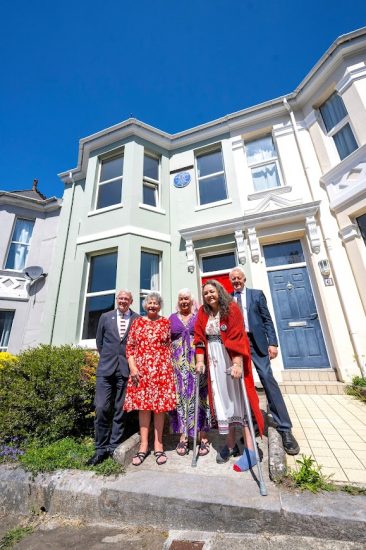
From the start, the idea has been to combine plaques for internationally-famous people with those for less well-known but fascinating individuals who we are thinking of as ‘quiet revolutionaries and unsung pioneers’. In the former category, we have unveiled plaques for ceramicist Clarice Cliff in Stoke on Trent, actor Cary Grant in Bristol, and musician George Harrison in Liverpool. For the latter, examples include the plaque in Ilkley for Daphne Steele, the first black midwife in the National Health Service, and, in Harpenden, the plaque for charity campaigner Judy Fryd, who founded Mencap. The full list, with details on all the people and the locations of the plaques, is here. In sport, the area for which I have a special responsibility on the panel, we have so far unveiled two plaques, both designed to celebrate individuals while also encouraging people to find out more. The first, in Plymouth, was for footballer Jack Leslie, who, in 1925, became the first black player to be selected for England, though the selectors then dropped him without any explanation. Then earlier this year, we unveiled a plaque in Buxton for Frank Soo, the first footballer of east Asian heritage to play for England. I’ve written about both unveilings elsewhere in this blog. We’ve got some really interesting new plaques in the pipeline, and we are looking forward to celebrating these significant individuals in the communities where they were from.

And now it’s over to you. The scheme works off public nominations, and the proposal period for the next wave of plaques opened last week. It runs until 13 January 2027. We’re really interested in getting an increasingly diverse range of people commemorated, and we’re keen on people who can spark conversations about all areas of history, including health, charity, arts and culture, gender, sport, education, politics, and so much more. If you have someone in mind who you think deserves a Historic England Blue Plaque, then check the nomination process and get to work. You can nominate individuals or small groups. The eligibility criteria give you guidance on the scheme’s scope. Remember, this scheme is for England outside of London: English Heritage’s London scheme is also currently open for nominations, so check that one as well if the person you wish to nominate had strong connections to the capital.
It’s not often you get a chance to shape the heritage landscape of your community, so get nominating!
Historic England’s National Blue Plaque nomination page: https://historicengland.org.uk/listing/national-blue-plaque-scheme/make-a-nomination/#first-steps
Listen to Howard Spencer and me explore the 1924 Olympians who have been commemorated with English Heritage Blue Plaques in London in Episode 274 of the English Heritage podcast: https://production.english-heritage.org.uk/visit/blue-plaques/blue-plaque-stories/olympic-heroes/#?theme=355&page=1
