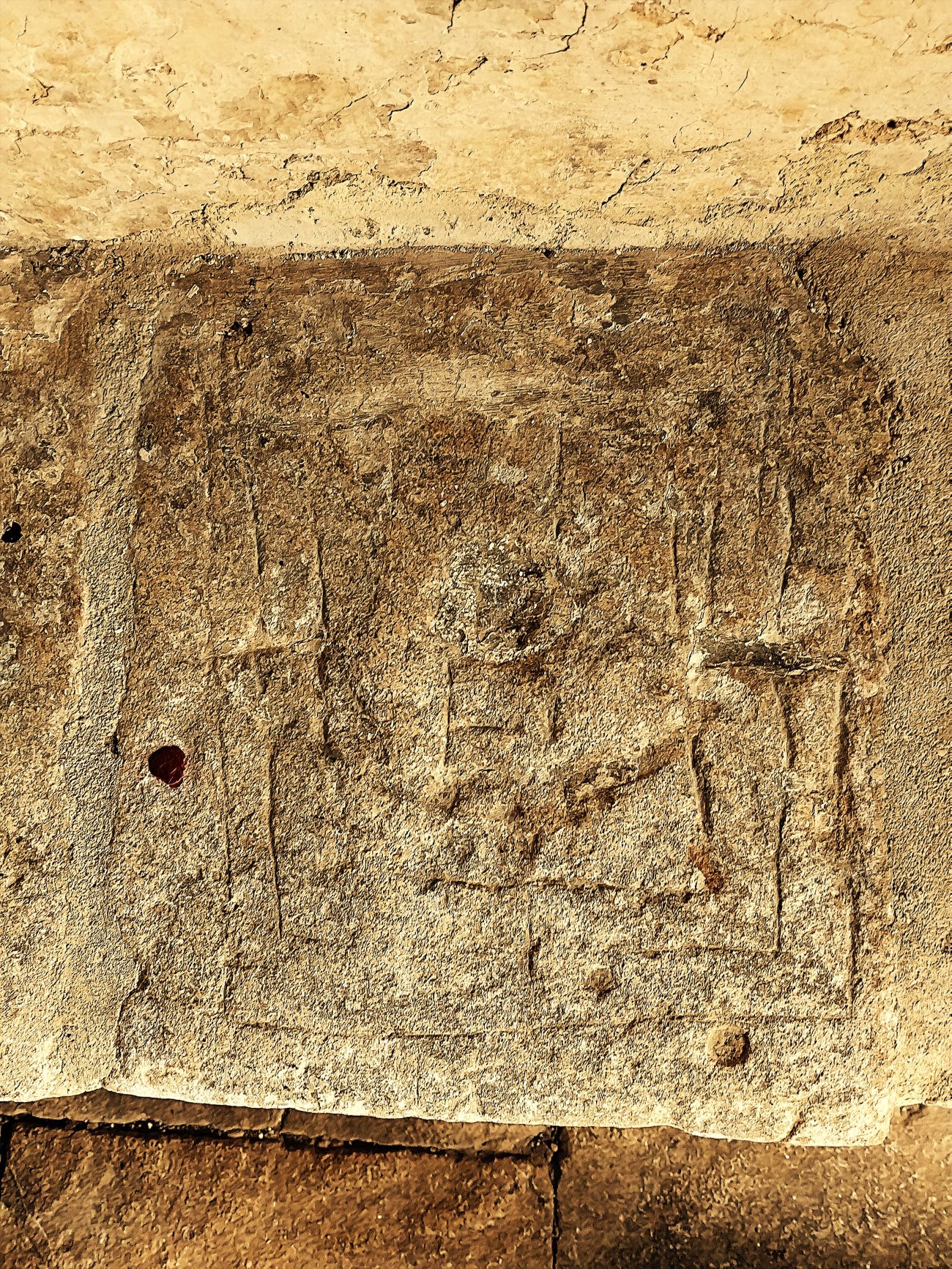
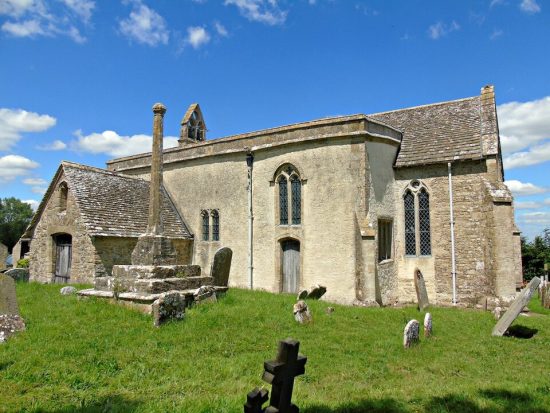
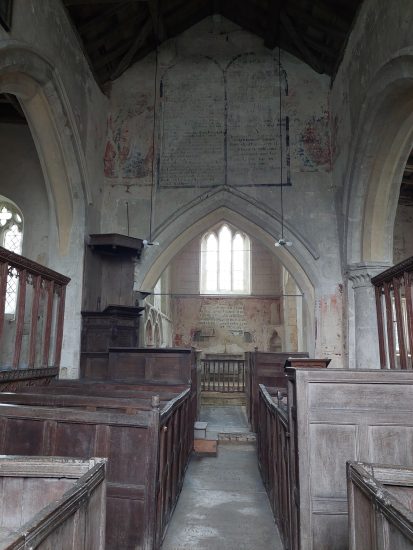
At the end of a small country lane in Inglesham, in the southern English county of Wiltshire, you can find the tiny church of St John the Baptist. The building dates from the thirteenth century CE, though it contains some older decorations, including a Saxon carving of the Madonna and Child. There are medieval wall paintings of angels and the Last Judgement, along with later biblical and liturgical texts. The socialist designer and architect William Morris helped to preserve the church in the late nineteenth century, and while it is no longer in use for worship, it is well-looked after by the Churches Conservation Trust. The church is on the Thames Path, and offers a calm and serene stopping point.
Amongst all of these architectural and artistic features, it’s easy to miss a small carving that takes us not into ecclesiastical history, but into the history of play. In the porch, where people have always waited for services and sheltered in bad weather, there a stone bench. And roughly carved into that bench is the playing surface for a game called Nine Mens’ Morris. It’s a wonderful trace of ordinary people in medieval England improvising in their surroundings to play a game.
Nine Mens’ Morris has ancient roots and goes under various names, including Merelles, Five-Penny Morris, and The Mill Game. It’s a strategy game a bit like noughts and crosses, with obvious similarities to draughts. I’ll let Joseph Strutt, the father of British sports history, describe it, using his account from the classic The Sports and Pastimes of the People of England, first published in 1801:
The manner of playing is briefly this: two persons, having each of them nine pieces, or men, lay them down alternately, one by one, upon the spots; and the business of either party is to prevent his antagonist from placing three of his pieces so as to form a row of three, without the intervention of an opponent piece. If a row is formed, he that made it is at liberty to take up one of his competitor’s pieces from any part he thinks most to his advantage…He that takes off all his antagonist’s pieces is the conqueror.
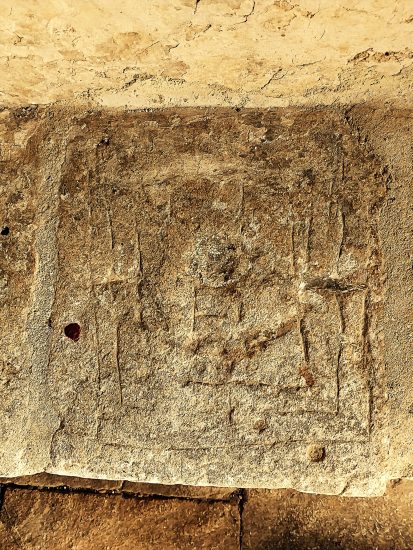
Textual and archaeological evidence suggests that versions of this strategy games were played in ancient Rome and Greece. Strutt described it as a game popular with shepherds and ‘other rustics’ who would scratch a board in the earth and use stones as the counters, and with children. The version in the porch at St John the Baptist, Inglesham, is similar to these earth-based boards, but whereas they were washed away by thed rain, this one has remained. It’s not the only version of this in an English church: board game historian R C Bell recorded similar carvings in Canterbury Cathedral, Westminster Abbey, and elsewhere. This one at Inglesham, though, remains special. It suggests an intimate link between this small village church and its medieval community, and how people will always find a way to play their games. Here, with small stones as counters and the makeshift board on the bench, any two people at any moment in the last seven or eight centuries, could sit out the rain with a few turns of this ancient game.
The poet T. S. Eliot wasn’t thinking about games when he wrote Little Gidding in 1942, but a phrase from that poem came to mind when I was visiting St John’s and thinking about the ‘rustic people’ playing Nine Mens’ Morris in the porch:
A people without history
Is not redeemed from time, for history is a pattern
Of timeless moments. So, while the light fails
On a winter’s afternoon, in a secluded chapel
History is now and England.
Check out @Greatbritisharchitecture on Instagram for their reel on the interior of St John the Baptist, Inglesham.
