I wasn’t planning to write about the men’s football World Cup this month, despite the 2026 tournament finishing last week with Spain’s victory in the final. There is far too much already out there, and sociologists, cultural studies people, sports law scholars, and historians will have a lot to go on from this tournament for years to come.
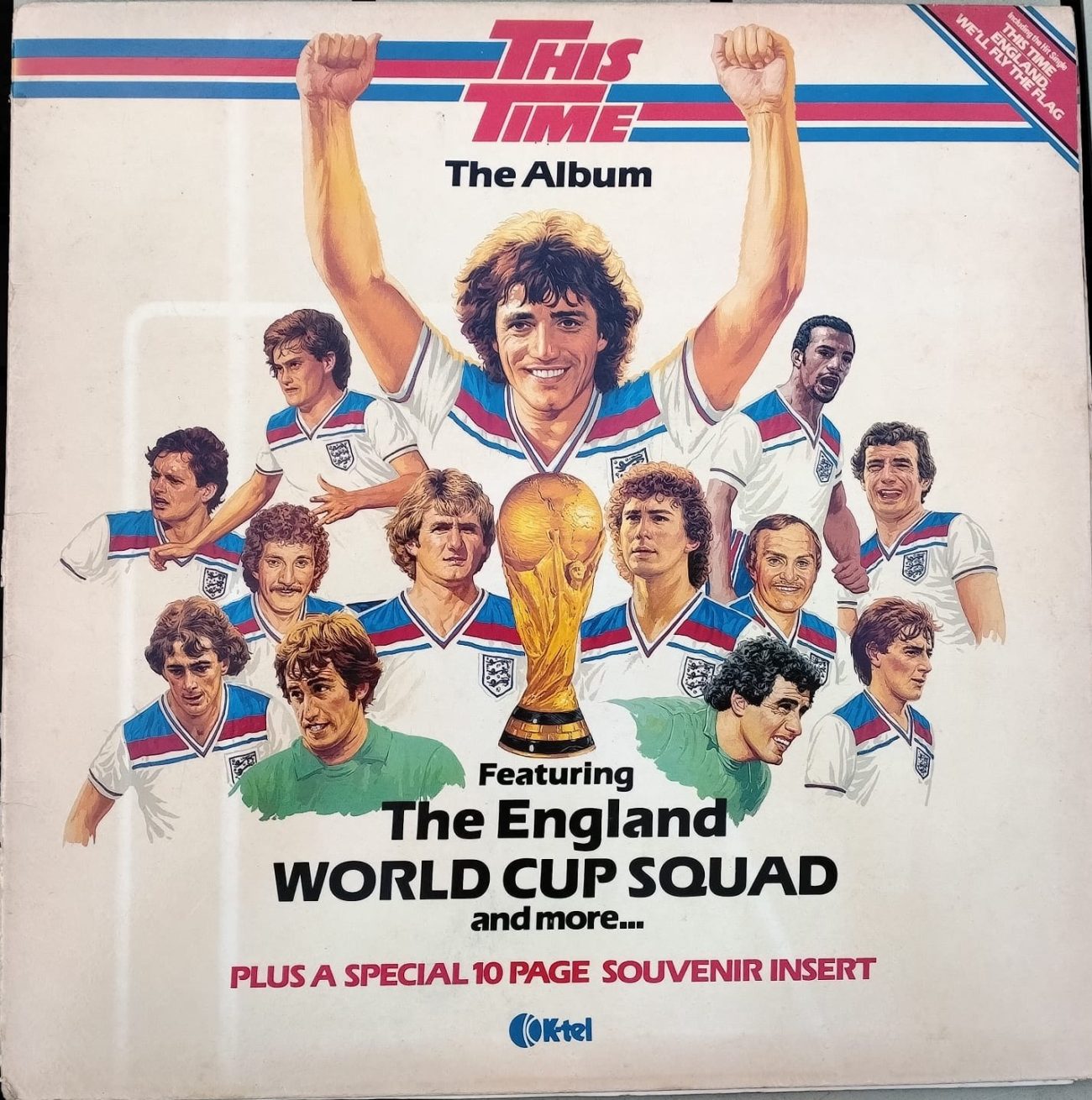
However, two things came together by coincidence in the weeks after the final that took me back to an earlier moment in World Cup history. One was the death, on 20 July, of former England player Kevin Keegan, who won 63 full caps between 1972 and 1982, and who was a fixture of the England team when I was watching a lot of football as a child and teenager. The other was the discovery, while sorting out some boxes in my loft, of This Time, the official England football team record from 1982, the only World Cup that Keegan played at due to England failing to qualify in 1974 and 1978. I didn’t buy the album – my son got it for me from a charity shop a few years ago as a bit of a joke, and as he knows I like collecting sporting ephemera. Keegan’s death, and the affection it inspired, and this disc making it out of the loft in the same week led me – with all of my irony excuses lined up – to give the record a spin.
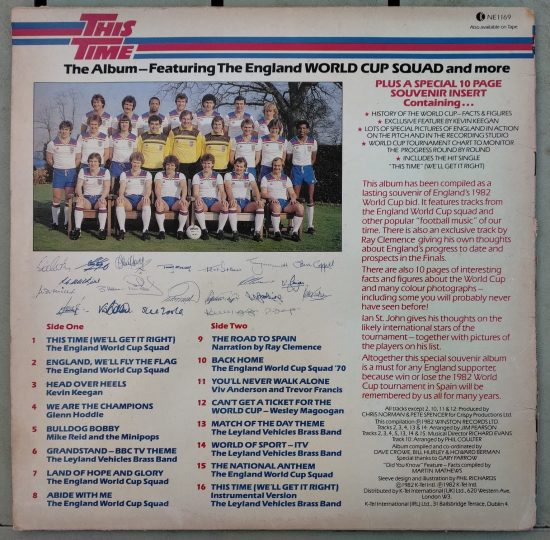
The album was on K-tel, a budget record label that specialised in releasing albums of hits re-recorded by session bands to sound as close to the original as possible. As a label it did not, as us kids who aspired to be cool and knowing about music in the 80s would have said, have street cred. The record kicks-off with ‘This Time (We’ll Get It Right)’, the England squad’s official song for the World Cup, which reached no 2 in the official UK singles chart, followed by that single’s B-side, ‘England, We’ll Fly The Flag’. After that, the album gets a bit random, though the sleeve noted describe the collection as featuring ‘popular “football music” of our time’ – I love the scare quotes. It includes the whole squad belting out the hymn ‘Abide With Me’, the National Anthem, and ‘Land of Hope and Glory’, along with the Leyland Vehicles Brass Band playing the theme tunes to television sports shows Match of the Day, Grandstand, and World of Sport. There’s some comedy mixed in, with TV presenter Mike Reid singing ‘Bulldog Bobby’, an ode to the England team’s mascot. Saxophonist Wesley Magoogan supplied ‘Can’t Get a Ticket for the World Cup’ – interestingly, this piece is missing from the allmusic.com listing of his work, which included stints with The Beat and the famous solo on hazel O’Connor’s ‘Will You’ – street cred again, I guess. The England World Cup Squad from 1970’s song ‘Back Home’ made its way onto Side 2, with Peter Shilton as the only player to appear on both the 1970 and the 1982 songs. Then space was found for a few of the squad to dazzle with their own musical talents. Glenn Hoddle – who later had a few hits with teammate Chris Waddle – made a brave attempt at Queen’s ‘We Are the Champions’, but he was no Freddie Mercury, while Viv Anderson and Trevor Francis duetted on ‘You’ll Never Walk Alone’. Kevin Keegan, as befitted his genuine celebrity status, had already had a hit with ‘Head Over Heels’, and that made it onto the album alongside these covers.
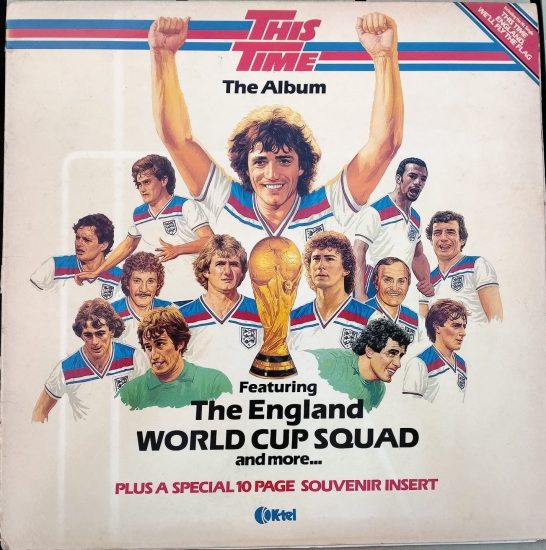
The album’s packaging was aimed very much at the football fan rather than the music fan. The red, white and blue colour scheme was consistent, the cover was adorned with designer Phil Richards’ illustrations of some of the players – Kevin Keegan dominating – and the gatefold sleeve included a traditional squad line-up photo and a collage of the players in the recording studio and on tour. These pictures were accompanied by a table of England’s record in the World Cup up to 1982 – the sole win of 1966 promoted in a much larger font than the three ‘Did Not Compete’ on the 1930s and the two sad ‘Did Not Qualify’ listings of the 1970s. To top it all, there was a pull-out booklet full of more facts ad figures, a wallchart for the World Cup, pundit Ian St John’s top twelve players to look out for – including, you guessed it, Kevin Keegan – and an essay by Keegan on his hopes for the tournament. It’s mostly predictable insider chat, but it ends on a timely appeal to the national team’s followers: ‘We will pull our hearts out for Ron Greewnood and our fans. I only hope that our supporters don’t let us down with behaviour which has disgraced the Union Jack in recent times’.
The hooligan reference and the common use of the Union Jack to stand for England add to everything else to make this album such an early 1980s time capsule. This is true of the music, too. It’s too easy to smirk at the record as one of those things that came out in the early 1980s as if punk hadn’t happened, but this happens to be true – and, in this case, it’s as if post-punk, disco, 2 Tone and any other new musical trend of the period hadn’t happened, either. The songwriters behind ‘This Time’ and the other new pieces were Chris Norman and Pete Spencer of the pop group Smokie, whose biggest hits ‘If You Think You Know How To Love me’ and ‘Living Next Door to Alice’ had happened in the mid-seventies. Those songs had been written for Smokie by the hit machines Nicky Chinn and Mike Chapman, and their mid-70s aesthetic had clearly rubbed off on their proteges. This gentle soft rock vibe then mixes in with the brass band contributions and the squad versions of hymns and anthems to create a collection that was safe and unadventurous, and that reminds us of football’s ambiguous culture at this time. On the one hand, hooligans were fighting each other and the police at home and abroad in the name of the England team, while some were buying and others shoplifting Lacoste, Fila, and Kappa gear to bring back home and spark the Casuals look; while on the other hand, the musical world in which the game’s establishment lived was as uncomplicated and as comfortable as a Val Doonican cardigan. Looking at the late great Kevin Keegan’s place in English football at this time through this pop cultural lens helps us to see a game with some very problematic faultlines.
When they got to Spain in the summer of 1982, the promise of ‘This time…we’ll get it right’ didn’t quite come off. England won their three group games against France, Czechoslovakia, and Kuwait, but then drew both of their games in the second group stage 0-0, and they left before the knockout rounds. Keegan, sadly, missed most of the tournament through injury, appearing only as a late substitute in the second-round match against hosts Spain, in which he famously headed wide for what all of us watching at home thought was a certain goal. Despite his overall contribution to the game at club and national level, including a stint as England manager, it is important to remember that Keegan’s World Cup tournament career lasted less than half an hour.
Jump forward eight years. Peter Shilton, Terry Butcher, and Bryan Robson were still in the England squad that headed to Italia 1990. This time, though – no pun intended – when it came to the official song, the game’s decision-makers had woken up not just to punk, but to post-punk, electronica, house, rap and pretty much anything else they could find. ‘World in Motion’, the squad’s collaboration with New Order, blew the old comfortable type of football record out of the water. A danceable, singable banger, with sampled commentaries and John Barnes’ immortal rap and the era-defining cry of ‘Express Yourself’, this song stands up as well now as it did in 1990. It’s there, along with Paul Gascoigne’s tears in the semi-final and the BBC’s use of Pavarotti’s rendition of Puccini’s aria ‘Nessum Dorma’ as its World Cup theme, as a symbol of the cultural revolution that English football was going through in the early 1990s. Listen to ‘This Time’ from 1982 and ‘World in Motion’ from 1990 back-to-back to get an instant sense of that revolution. Then try Kevin Keegan’s ‘Head Over Heals’ against John Barnes’ rap with New Order to appreciate the changing off-pitch role of players in this time of flux.
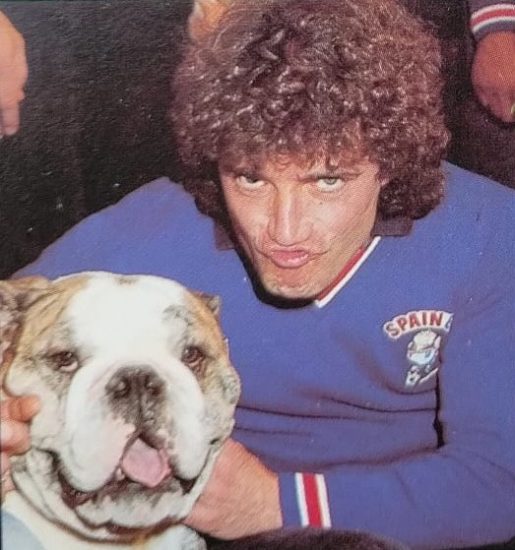
Spain 1982 was not Keegan’s finest moment on the pitch, but listening to this album in the wake of his death serves as an affectionate reminder of English football’s culture from what increasingly feels like another age.
