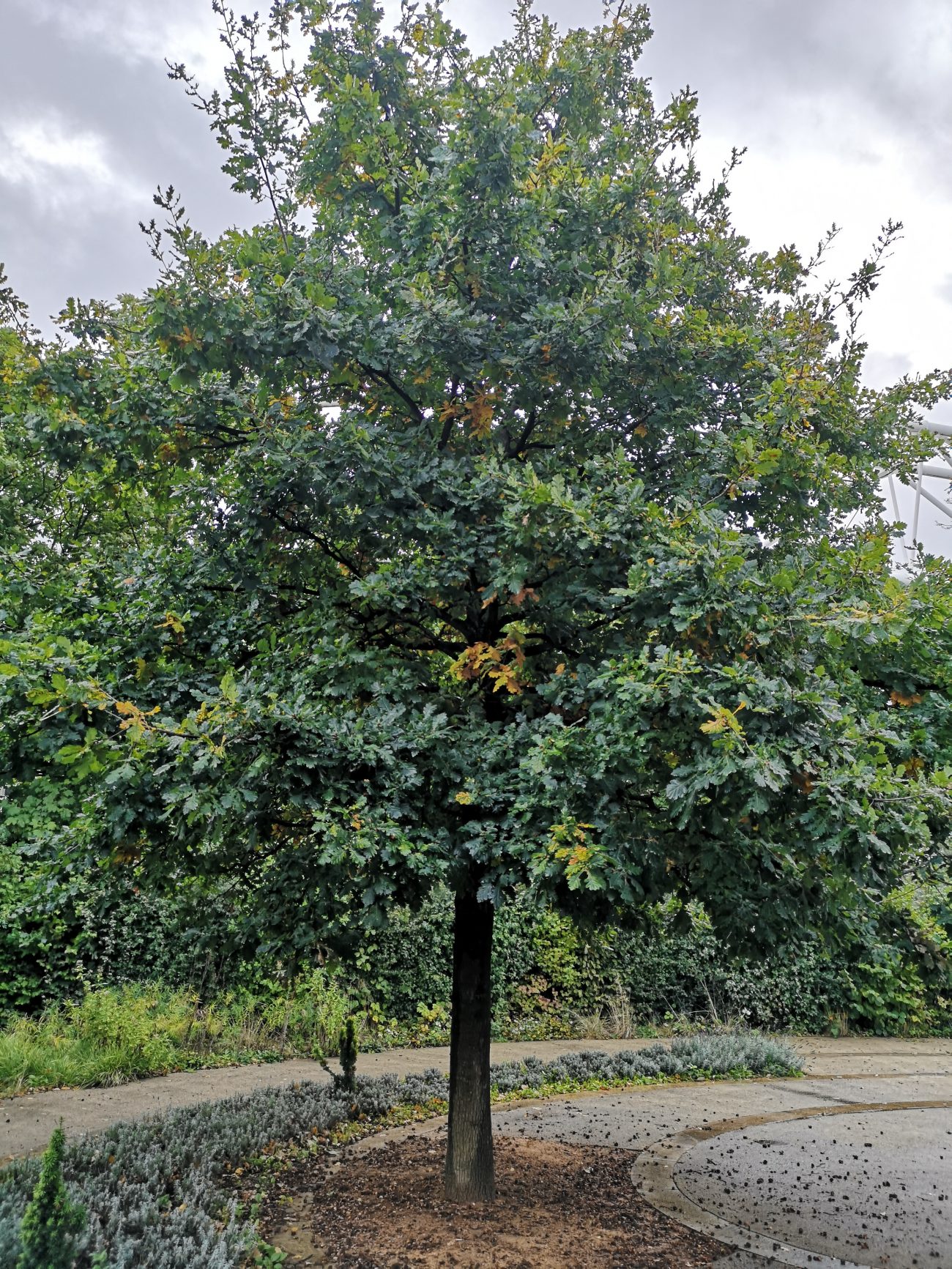
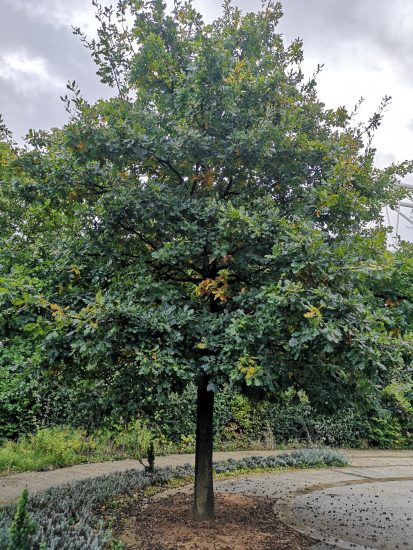
Earlier this month, I paid a visit to the Queen Elizabeth Olympic Park in Stratford, East London. This space was the heart of the 2012 Olympic Games, and I was there leading a tour for a group of students from Carleton College in Minnesota, USA, as part of their Global Sport residential module in London. After focusing on the big sporting sites that that Olympics left behind, like the London Stadium, the Aquatics Centre, the Velodrome, we looked at some of the arts and educational sites that have grown at the Park in the legacy phase, such as V&A East and the Sadler’s Wells East. And then… I took them to see a tree. The Great British Garden sits in the shadow of the London Stadium, and it contains a thriving oak tree that links in to the history of the Olympic Games.
The tree’s story begins in the Shropshire market town of Much Wenlock, roughly 170 miles north-west of the Olympic Park. In the 1850s, a local doctor and philanthropist, William Penny Brookes, started an Olympian Class for the young people of the town as an off-shoot from his educational projects. The Class soon evolved into the Wenlock Olympian Society, and it staged annual games, called Olympian Games, for the people of the town and the wider region. These games included athletics, equestrian sports, bicycle races, and military exercises, along with more light-hearted events like the wheelbarrow race, prison base, and jingling. There were also educational and industrial competitions in poetry, essay-writing, painting, knitting, and more.
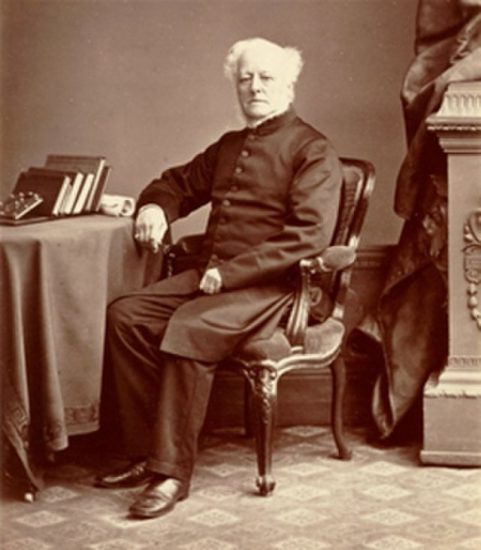
The Olympian Games were still going strong in 1889 when Pierre de Coubertin, a minor French aristocrat who was interested in sport and education, made contact with Brookes through a letter in the English press. Brookes invited Coubertin to see the Wenlock Olympian Games, an invitation that led to a visit in October 1890, when Brookes staged a special edition of the Games for this honoured guest. Brookes loved ceremonies, and he invited Coubertin to plant an oak tree at the edge of the field where the sports took place, as a permanent, living reminder of the visit. ‘May this tree flourish for ages,’ Brookes said in his speech, ‘and always be looked upon with feelings of pleasure, and of respect for Baron Pierre de Coubertin’. After pouring a libation of champagne on the sapling, Coubertin replied, thanking Brookes for the tree, and expressing his hope that it ‘would tend to cement the friendly feeling between our two countries which ought to be everlasting.’ The whole affair helped to move Coubertin towards the idea of setting up an international Olympic movement: and while he later played down Brookes’ role, one of his successors as International Olympic Committee President, Juan Antonio Samaranch, later paid homage at Brookes’ grave in Much Wenlock, describing the Victorian doctor as the ‘true founder’ of modern Olympism.
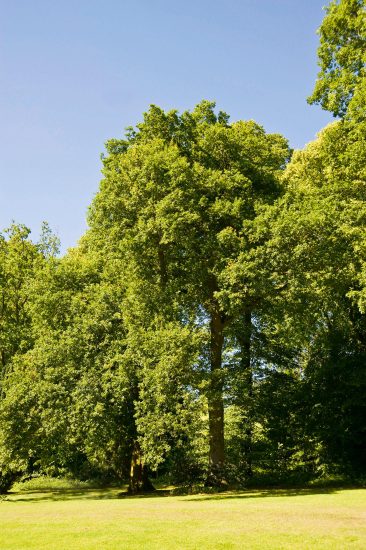
The Coubertin Oak is still there, flourishing in its spot on the Gaskell Recreation Ground. It’s marked with a plaque to commemorate Coubertin’s visit. The original plaque, bearing the legend ‘Quercus Concordia / Planted in honour of / Baron Pierre de Coubertin / Oct 22nd 1890’ is in the town’s museum. The Olympian Games still take place annually, and any visitor can pay their own respects to this living link to Coubertin.
How does this relate to the tree in London? It’s all about legacy. When London was bidding for the 2012 Olympics, children from the local school – named, of course, for William Penny Brookes – collected acorns from the Coubertin oak. As some grew into saplings, the Royal Botanic Gardens in Kew took them on, and the oak now in the Olympic Park is one of the trees that resulted from this community project. It was this tree that I took the American students to see, and I’m genuinely delighted to say that quite a few of them hugged it. Kew has kept one of the trees in its own collection – I’ll look for that on my next visit.
In 2023, the editors of A History of Sport in Europe in 100 Objects, Daphne Bolz and Michael Kruger, invited me to write an entry on any object of my choice connected with Olympism. I chose the Coubertin Oak. At a time when the Olympic Games are both victims of the climate crisis and complicit in environmental damage, including the destruction of trees, I saw the Coubertin Oak as a living object that can tell us stories about balance, longevity, and the essential relationship that sport has with the natural world.
